Wednesday, June 17, 2015

How To Find Us

  How to Find Us


We've moved from our old Blogger blogs, and made a few changes. Below are some places you can find us!


Character Ink Blog          


First, you can find us on our Character Ink blog! Here I blog about parenting, homeschooling, marriage, character training, language arts, home management, low-carb/healthy cooking, grammar, reaching the hearts of your children, and teaching. CharacterInkBlog.com  


findus  


Second, you can find us on three Facebook pages:

 Character Ink!  

Raising Kids With Character

 Language Lady


Note: We are closing the Training for Triumph Facebook page, so be sure to go over and like our Character Ink page for homeschooling and more, and the Raising Kids With Character page for parenting in general.      


Third, you can listen to our Wondering Wednesday podcasts episodes at our blog AND in iTunes!     


CQLA Samples  


Fourth, you can see samples of our curriculum, print them off, and try them out here for CQLA and here for Meaningful Composition. Check back here often as we are adding the new Meaningful Composition books through summer 2015.


    Calling Character Ink!


 Finally, you can call or email us directly to place an order, to sign up for classes, or to schedule a speaker or a parenting seminar.  

Email us: characterink@gmail.com OR characterinklady@gmail.com  

Call us: 260-450-7063 260-433-4365  

Write us: Ray and Donna Reish
11120 Aboite Center Road
Fort Wayne, IN 46814  


You can also find us on Pinterest, and in our weekly e-newsletters that contain articles, recipes, parenting helps, language arts teaching, and more. Sign up here! And click here to see previous newsletters :)


See you soon!

Sunday, February 9, 2014

Rise/Raise and Sit/Set and Lie/Lay Tips

Many hands rising the sky together, children and adults - stock photo


Sit and rise have I's--and lie does too.
"Coz these are things that I, all by myself, can do.
Set, raise, and lay are words that you choose
When each one has an object after it to use.


I am going to take sit/set; rise/raise; and lie/lay one pair at a time over the next few days; however, I wanted to start the series (or at least this second post) with teacher tips.

I have watched kids with glossed over eyes as I have tried many techniques and order to teach these tricky pairs, and have had many difficulties “rise” up and confuse them (and me!):

  1. People lie; things get laid down—sort of works, but it’s not just people who lie—the sun lies on the horizon; the city lies asleep in the early morning hours; the animal lies in the middle of the road….you get the idea
  2. People lie; things get laid down—but it still didn’t help with the sit/set and rise/raise dilemma
  3. The past tense of lie (as in yesterday I lay down to take a nap…don’t I wish!) is the same as the current tense of lay (as in I am going to lay the book on the table)—poor kids!
  4. And so many more!

So here are a few tips that I would like to pass along to those trying to teach these rules:

  1. Consider a rhyme or mnemonic like the one above to reinforce the I’s in sit, rise, and lie—when we remind students that I do those things—and they have I’s in them, we are helping them remember that these do not have objects following them.
  2. Do NOT start with lie. It is by far the most confusing of the trio—and I try to do that one after rise and sit (with fewer exceptions, etc.) are established in students’ minds.
  3. DO start with sit. Set has the same tense for all—present; past; and past participle. Today I set the table; yesterday I set the table; before that I have set the table.
  4. If you are teaching from a Christian standpoint, Jesus and God are prime examples of rise/rose/has risen and raise/raised/has raised:
    1. Jesus will rise from the grave. God will raise Jesus.
    2. Jesus rose from the grave. God raised Jesus.
    3. Jesus has risen from the grave. God has raised Jesus.

  1. Suggested order: sit/set; rise/raise; and lie/lay.

Happy teaching—and learning! J


Thursday, January 23, 2014

U is for UNUSUAL SPELLING--Facade


You know what one of my least favorite words is? FACADE.

First of all, I work week in and week out to try to teach that an A, O, U, or most consonants make the C say "kuh." That would make this word fuh-kade, right? (Or even fay-kade.) Unfortunately, that is wrong.

It is pronounced fuh-sodd. (That A really doesn't make the C say "kuh.")

That clearly makes this word a FAKE, which is one of its only redeeming qualities--it means what it looks like! Smile...

That bring us to the second aspect of the word--its meaning. It is a noun that means "a face of a building or a superficial appearance."

In that regard, it is as it is pronounced--even though it isn't pronounced like it is spelled (which is true of many words that came from somewhere else).

So it is easy to learn the meaning of---it has to do with what it sounds like--FACE (albeit, a fake face). But it is not spelled as one would think.

So, don't put on a facade today! Don't try to put on a superficial front or fake face. Be yourself!

Wednesday, January 22, 2014

U is for UNUSUAL SPELLINGS: Wednesday


So many of my students have trouble spelling today’s day of the week! Wednesday is definitely not phonetic, so students (and adults!) get stuck on the spelling of it. Most people say Wednesday without the sound of the d at all.

We teach our students to spell difficult words in many ways, giving them as many tools as we possibly can.

1.    Syllable by syllable—longer words that are phonetic in nature can often be syllabicated and spelled syllable by syllable by a student who is fairly phonetically-savvy: con/se/quence.

2.    Tricks and mnemonics—we call these “Tricky Tricks to Help It Stick” and use them often with our “Wacky Words”—words that have a wacky counterpart that can be confusing, such as the homophones their, there, and they’re. I had an elementary student this year who told the class that they could easily spell Nebuchadnezzar if they just divided it up and pronounced the ch as choo (not kuh): Neb/U/Chad/Nez/Zar! Of course, any tricks that help a person are handy tools to have (though the trick must help that person in order to be effective).

3.    Visual tricks—many visual people spell by “seeing” the word—its shape, its sequence of letters (and the shapes those letters make), etc.

4.    Memorization—some people  are just naturally good spellers (it is now thought to be a specific skill set separate from intelligence) and can memorize a word’s spelling once it is seen.


How do YOU spell Wednesday. Many of my students say it just like it looks to spelll it: WED/NES/DAY!
Does that help you?

Sunday, January 12, 2014

S is for SUBORDINATE CLAUSE OPENER--Putting It All Together!

I teach subordinate clause openers extensively in my books because punctuating them properly is key to sentence writing. 


Do you remember what a subordinate clause is from yesterday? A subordinate clause is a sentence (independent clause-can stand alone) that has a subordinator added to the beginning of it (which makes it a dependent clause-is dependent upon something else in order to be used {has to have a real sentence put with it in order to be used}).

Think of subordinate clauses by either of their two names:

1. Subordinate clause--subordinate to the rest of the sentence
2. Dependent clause--dependent on something else to go with it (a real sentence/independent clause) in order to be used


Click here if you need to brush up on subordinators via our Subordinator-Check Sentence or subordinate rhyme.


Subordinate Clause Opener: Now for the opener part.

If you have been reading Language Lady for long, you have learned that a sentence opener has the following characteristics:

1.      It gives a sentence more information.

2.      It comes at the beginning of a sentence, which gives a paragraph a
different rhythm than if it included all subject-verb patterned sentences.

3.      It is often set off with a comma-again, adding to the rhythm of your
sentences.

4.      It si usually non-essential, meaning that the senence is still a
sentence without the addition of an opener.

5.      It shows advanced writing skills because a writer who has a handle
on the many varieties of sentence openers has a large toolbox of sentence structure at his disposal.


So...if a subordinate clause is a group of words that contains a subordinator+subject+verb, then a subordinate clause opener is a subordinator+subject+subordinate clause that is used as a sentence opener.

Simple enough, huh?

The tricky parts of subordinate clause openers are

(1)   Be sure that you never use a subordinate clause opener by itself,
thinking it is a sentence. (It will sound like something is missing-because it is-the real sentence!)

(2)   Be sure that you put a comma following a subordinate clause opener.

When you start a sentence with a subordinate clause, 
Put the comma in when you hear the pause!


Here are some complex sentences created with subordinate clause openers attached to "real" sentence. In grammar lingo, each one is a complex sentence because it has a dependent clause (subordinate clause) at the beginning attached to an independent clause (real sentence).


If you learn subordinators well, you may write sentences with subordinate clauses.

If you put a dependent clause at the beginning of a sentence, put a comma in before writing the real sentence part.

As you learn more and more about sentence structure, your writing will improve.

Since people are impressed by good grammar and strong writing, you will become an impressive person as you learn grammar usage.

When you start a sentence with a subordinate clause, put the comma in where you hear the pause.

Although many people do not remember much about dependent and independent clauses, this does not make these clauses unimportant.

Because I want to write well, I am working on my usage skills.

Though some consider analyzing sentences as outdated, I know that it helps me write better.


If you lasted to the end of this lesson, you will be able to write well with subordinate clause openers!

Thursday, January 9, 2014

S is for SUBORDINATE CLAUSE OPENERS--Understanding the Subordinate Clause


Studying subordinators, subordinate clauses, and subordinate clause openers...


Did you memorize subordinators, so you can write with subordinate clause openers properly? If not, you can find the post on there here.

Once you memorize subordinators, you are ready to write with subordinate clauses. Specific to this lesson, you will be ready to write subordinate clause openers (subordinate clauses that are added to the beginnings of sentences).

As far as a subordinate clause is concerned, it contains a subordinator and a subject and a verb.

Subordinator + Subject + Verb


When she drove,

As he said,

After she left,

When they arrived,

Because he smiled,


Did you notice anything about those subordinate clauses? If you noticed that each one would be a sentence if the subordinator were removed, you are correct!

A subordinate clause is a sentence (subject + verb) that has a subordinator at the beginning of it!

Sentence: She drove.
Subordinate clause:  When she drove,


Sentence: He said.
Subordinate clause: As he said,


Sentence: She left.
Subordinate clause: After she left,


Sentence: They arrived.
Subordinate clause: When they arrived,


Sentence: He smiled.
Subordinate clause: Because he smiled,


So....a subordinate clause is a sentence (independent clause-can stand
alone) that has a subordinator added to the beginning of it (which makes it a dependent clause-is dependent upon something else in order to be used {has to have a real sentence put with it in order to be used}).

Think of subordinate clauses by either of their two names:

1. Subordinate clause--subordinate to the rest of the sentence
2. Dependent clause--dependent on something else to go with it (a real sentence/independent clause) in order to be used

Tuesday, January 7, 2014

S is for SUBORDINATE CLAUSE (Starting With SUBORDINATORS!)

Image from linguisticsgirl.com


When you start a sentence with a subordinate clause,
Put the comma in when you hear the pause!


That is a cute rhyme (don't you think?)....but unless you know what a subordinate clause is (and prior to that, what a subordinator is), it will not do you much good to recite it. So this post will go back to what subordinators are first. 

Maybe you were taught that subordinators (words that make the part of the sentence that they are in be "subordinate" to the rest of the sentence) are called other things, like conjunctives or subordinate conjunctions. Some grammar handbooks do not even classify subordinators at all but call them whatever other class they fall under (i.e. the preposition before might always be called a preposition, even though it is a subordinator when it has a subject and verb following it).

Regardless of what you were taught about subordinators, they are extremely important to good writing. Why? 

A subordinator is a word that falls at the beginning of a subordinate clause.

A subordinate clause has the following characteristics:

1. It is a group of words that begins with a subordinator and has a subject and verb following it.

2. It is subordinate to the rest of the sentence--that is, it is "less than" the real sentence.

3. It may not stand alone as it is not a real sentence.

4. It sounds as though something is missing when it is read--because something is (the real sentence!).

5. It may be joined with a complete sentence to create a complex sentence, but the subordinate clause may never stand alone.

So....what are subordinators?

Let's start with the first six that we teach our youngest language arts students in our books:

Since, when, though
Because, if, although.

Yeah, it's a rhyme! Cute, huh? (I love teaching!)

Anyway, for you older folks, we have a Subordinator-Check Sentence that most subordinators fit into. 

In a nutshell, if a word fits in the check sentence and the word is not an adverb, it is likely a subordinator:


________________________ the submarine went down, we could no longer see it.


Since the submarine went down, we could no longer see it.


When the submarine went down, we could no longer see it.


Though the submarine went down, we could STILL  see it.


Because the submarine went down, we could no longer see it.


If the submarine went down, we could no longer see it.


Although the submarine went down, we could STILL see it.

Okay, those are the first six.

 Here is a lengthy, but not exhaustive list of subordinators:

-after (also a preposition when it just has an object following it)
-although
-as (also a preposition when it just has an object following it)
-as if
-as long as
-as soon as
-as though
-because
-because of (also a preposition when it just has an object following it)
-before (also a preposition when it just has an object following it)
-even
-even if
-even though
-if
-inasmuch as
-in order that
-lest
-now (more commonly used as an adverb)
-now since
-now that
-now when
-once
-provided
-rather than
-since
-than (also a preposition when it just has an object following it)
-that
-though
-til (also a preposition when it just has an object following it)
-unless
-until (also a preposition when it just has an object following it)
-when
-whenever
-where
-where ever
-where as
-whether
-which
-which ever
-while
-who
-whoever
-why


In as much as the submarine went down, we could no longer see it.

Until the submarine went down, we could STILL see it.

While the submarine went down, we could no longer see it.


 We will stop here and give you time to memorize these before we go on in a day or two working on punctuating sentences that begin with subordinate clauses. Just looking at the Subordinator-Check Sentence, though, you can probably deduce that the first rhyme in this post is accurate: a subordinate clause opener is followed by a comma. More later!

Sunday, January 5, 2014

S is for SUBORDINATE CLAUSE---Phrases and Clauses


Image from languagearts.ppst.com

We talked about PREPOSITIONAL PHRASES when we did the letter P a while ago. Now we are going to move into S--SUBORDINATE CLAUSES.


We have talked at length about what a sentence contains:

C apital

A ll makes sense

V erb

E nd mark

S ubject

CAVES!

Again, most people have trouble witht the A one--All makes sense. When a "sentence" doesn't make sense, it is often because it is not a sentence at all, but it is a phrase or a clause.

We are going to talk in detail about phrases and clauses in the upcoming weeks because we are going to talk a lot about sentence structure--openers, simple sentences, compound sentences, etc.

So...a little "phrase and clause" lesson is in order first:


1. Phrase--

a. Group of words

b. Group of words that is not a sentence

c. Group of words that is not a sentence and does not usually contain a subject and a verb (though may seem to have one or the other)

d. There are various types of phrases--the one that people are most familiar with is the prepositional phrase--begins with a preposition and ends with the object of the preposition:
      i. over the clouds
     ii. into the clouds
    iii. around the clouds
   iv. within the clouds
    v. under the clouds


2. Clause

a. Group of words

b. Group of words that might or might not be a sentence

c. Group of words that contains a subject and a verb

d. Two kinds of clauses

     i. Independent clause--also called a sentence

     ii. Dependent clause--also called a subordinate clause


Don't despair! These are not as complicated as they sound! You write with them all the time--but I hope to help you recognize them and punctuate them correctly in sentences--over the next few weeks!

Happy writing!

Saturday, January 4, 2014

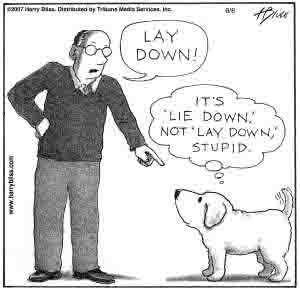
Lie vs Lay


Sit and rise have I's--and lie does too.
"Coz these are things that I, all by myself, can do.
Set, raise, and lay are words that you choose
When each one has an object after it to use.

Here we are at the end of our Wacky Word pair—lie and lay.

Remember these lie and lay tips:

  1. Lie has an I—and I alone can do it (it is not done TO something else).
    1. I lie in bed at  wide awake.
    2. Yesterday I lay awake half the night.
    3. Before that I had lain down when the cat jumped on me.

  1. Lie means to stretch out in a flat position—anybody or anything can lie, as long as it does it by itself (i.e. it is NOT laid)
    1. She lies down with a headache every day.
    2. The sun is lying low.
    3. She has lain down for a nap.

  1. Lay must have an object following it—something that it is being laid down.
    1. Lay your book on the table.
    2. He laid his money down.
    3. She has laid the towels in the sun.


Okay…the tenses for the three:

1. Lie
            a. Base form: lie—Tomorrow I will lie down early. (Remember—no object; down is an adverb; early is an adverb here, not an object.
            b. Past simple: lay—Yesterday I lay in the sun. (Tricky part: past tense of lie is lay; lay is also the present tense of lay—to lay something down!)
            b. Past participle: lain—They have lain low ever since then.
            d. Third person singular: lies—The dog just lies under the tree all day long.
            e. Present participle/gerund: lying—The sun was lying on the horizon for so long today.


2. Lay
      1. Base form: lay—I lay the kids’ clothes out every day. (Tricky: lay is the base form of lay (to put something down; it is also the past tense of lie—to stretch out by yourself or itself.)
      2. Past simple: laid—Yesterday I laid the pink pants out for Jon.
      3. Past participle: laid—Before the dog came in, I had already laid his bones out.
      4. Third person singular: lays—He lays the book down every night at ten.
      5. Present participle/gerund: laying—I am laying the swim suits out to dry.


Tricky Tricks to Help It Stick

  1. Again, do sit/set first (all same base word for tenses of set!) or rise/raise (since many people get this pair correct even if they do not know sit/set and lie/lay very well).
  2. Do rise/raise after sit/set or sit/set after rise/raise (saving lie/lay for last).
  3. Memorize acronym/rhyme to cement the fact that all three with I’s are the ones that are done by someone or something (not to something).
  4. When you get to lie and lay, to lie first all by itself until it is memorized. Then do lay. (I am starting to wait a week between the two with lots of practice on lie during that week before moving on to lay.)


I’m officially done with sit/set; rise/raise; and lie/lay! Time to move on. I feel that I have risen to the occasion and am glad that I did not sit idly by and lay these tricky ones aside. Glad I did not let people lie in agony over these Wacky Words. I would like for all of us to set our grammar burdens aside and raise a toast in honor of sit/set; rise/raise; and lie/lay! J (Last time for a while, honest!)

Tuesday, December 31, 2013

Sit and Set Pop Quiz With Answer Key!


      Sit Down While I Set Up a Quiz For You!


Sit and rise have I's--and lie does too.
"Coz these are things that I, all by myself, can do.
Set, raise, and lay are words that you choose
When each one has an object after it to use.


Fill in the blanks below with the correct forms/tenses of sit/set.

  1. She _________ down and wept when she heard the news.
  2. They _______ down.
  3. They _______ the plants out.
  4. They will be _______ the clothes out beforehand.
  5. Yesterday, he ________ down to rest.
  6. They will ________ the clothes out to dry.
  7. He _________ down.
  8. He is ____________ down.
  9. They will be _________ the clothes out beforehand.
  10. She has _________ the clothes out beforehand.
  11. They have __________ down.
  12. He has ____________ down.
  13. They __________ the trap to catch the bear.
  14. They are __________ down.
  15. They will ________ the tent up at .


ANSWER KEY:


  • She sat down and wept when she heard the news.
  • They sit down.(or sat)
  • They set the plants out.
  • They will be setting the clothes out beforehand.
  • Yesterday, he sat down to rest.
  • They will set the clothes out to dry.
  • He sits down.
  • He is sitting down.
  • They will be setting the clothes out beforehand.
  • She has set the clothes out beforehand.
  • They have sat down.
  • He has sat down.
  • They set the trap to catch the bear.
  • They are sitting down.
  • They will set the tent up at .
  • Wednesday, December 25, 2013

    Merry Christmas from Language Lady!


    This time of year we see a plethora of spelling, capitalization, grammar, and usage errors--on signs, catalogs, greeting cards, and more:
    1. merry Christmas on a greeting card (which technically isn't wrong, but just doesn't look right either!)
    2. "This line is for eight items or less"--even though it should be "eight items or fewer"
    3. Xmas--even though the Associated Press itself says to never use this abbreviation!
    4. Seasons' Greetings (which indicates that you are offering someone greetings for more than one season--the plural noun seasons)
    5. Happy capitalization guy or girl--Christmas Tree, Christmas Decorations, Christmas Ham, etc.

    Many holiday greetings and terms are subjective (shocking, huh?); however, here is a list to help you see the most common ways that greetings and holiday words are expressed this time of year:

    1. You can write any of the following:
    a. Seasons Greetings (no possession shown at all--more of a noun describing another noun)
    b. seasons greetings (same as a., but no capitalization--not recommended for greeting cards and headers)
    c. Season's Greetings (the most common way, showing that the season {one season} possesses the greeting; note the capping here)
    d. season's greetings (like c but not capped)

    2. Of course, people also write Merry Christmas in different combinations (with and without the M capitalized; however, Christmas should always be capitalized because it is a proper noun by itself:
    a. merry Christmas
    b. Merry Christmas

    3. To cap or not to cap greetings? This is a stylistic preference, but if it is in a header or greeting card, you definitely want to capitalize:
    a. Season's Greetings or season's greetings
    b. Merry Christmas or merry Christmas
    c. Happy Holidays or happy holidays
    d. Happy New Year or happy New Year
    e. Happy Christmas or happy Christmas
    f. Happy Christmastime (all one word) or happy Christmastime (again, all one word)


    4. Words that are already proper nouns should remain proper nouns in every context and should retain their capitalization:
    a. Santa Claus
    b. Poinsettia--This is traditionally capitalized because the flower is named after a botanist and physician who was also the first US Ambassador to Mexico, Joel Roberts Poinsett. In 1828, he introduced the plant to the country.
    c. The actual holidays
         i. Christmas or Christmas Day
          ii. Christmas Eve
         iii. New Year's Eve (one year--singular YEAR.....hmm...."that doesn't end in an s, so I need to put apostrophe s")
         iv. New Year's Day

    d. North Pole (Remember--you capitalize directions when they are part of a proper noun already--but not when giving directions. No "Turn West at the corner"!)
    e. Jesus, Jesus Christ, Messiah--most Christian publications capitalize names for or references to God and Jesus
    f. All locations associated with Christ's birth and life as they are proper nouns already--Bethlehem, Nazareth, etc., and, of course, King Herod, Joseph, and Mary (but not shepherds or wise men)
    g. When describing decorations, only capitalize the original proper noun:
         i. Christmas tree
         ii. Christmas wreath
         iii. New Year's Day dinner
         iv. Christmas Eve party

    h. Nativity is capitalized when it stands alone or when it is combined with non-proper noun elements
         i. Nativity scene
         ii. Nativity pieces
         iii. Nativity story

    i. Advent is capitalized in all contexts 

    Merry Christmas from Language Lady! 

    Tuesday, December 17, 2013

    Raise vs. Rise


    RAISE a toast! Use an object with RAISE....toast is the object.


    Sit and rise have I's--and lie does too.
    "Coz these are things that I, all by myself, can do.
    Set, raise, and lay are words that you choose
    When each one has an object after it to use.


    I like to start with the simplest Wacky Word pair—RAISE AND RISE--though I have often thought sit/set was the easiest pair because all of the set forms are the same. However, raise and rise are less often misspoken or mis-written, so I have changed my thoughts on this. 

    Remember these RISE and RAISE tips:

    1. Rise has an I—and I alone can do it (it is not done TO something else).
      1. I RISE early.
      2. Yesterday I ROSE early.*
      3. Before that I had RISEN early.
    *Just think I RISE early, and Rose ROSE early...

    1. RISE means to head upward—anybody or anything can rise, as long as it does it by itself (i.e. it is NOT RAISED)
      1. The sun ROSE early...all by itself.
      2. I RISE before dawn (not really!).
      3. They are RISING up in protest.
      4. She has RISEN from that position one time.
      5. They are RISING in honor of the king. 
      6. We have to wait for the bread to RISE.


    1. RAISE does not have an I (first)—it is done TO something.
    2. RAISE must have an object following it—something that it is being RAISED.
      1. RAISE the flag..
      2. Did he RAISE a toast?
      3. They will not RAISE the drawbridge today.
      4. She had some definite opinions to RAISE at the meeting.
      5. The kids RAISED a raucous to get attention.
      6. We RAISED our voices in protest.
      7. How much money did we RAISE?

    1. RAISE is the same base word for all of its tenses: RAISE, RAISE, RAISED, RAISING.  That is why I recommend teaching this Wacky Word pair first (of the three), along with the fact that people do not usually say, "I rose my glass for a toast," so it is more familiar, thus making it easier to learn (going from the known to the unknown, the familiar to the unfamiliar).


    Okay…the tenses for the pair:

    1, RISE
                a. Base form: RISE—Today I RISE early.  (Remember—no object; early is an adverb here, not an object.
                b. Past simple: ROSE—Yesterday I ROSE early..
                b. Past participle: RISEN—Before that, I had RISEN early.
                d. Third person singular: RISES—He RISES early.
                e. Present participle/gerund: RISING—I was RISING early.

    2. RAISE
          1. Base form: RAISE—Today I RAISE my voice in the meeting.  (Object—voice)
          2. Past simple: RAISED—Yesterday I RAISED my voice in the meeting.
          3. Past participle: RAISED—Before that I HAD RAISED my voice in the meeting.
          4. Third person singular: RAISES—She RAISES her voice in the meeting.
          5. Present participle/gerund: RAISING—I am RAISING my voice in the meeting.


    Wednesday, October 30, 2013

    O is for ORGANIZING FOR WRITING--Some Tips for Helping Young Children Organize for Writing

    Sometimes it takes more than a cool binder (and even some awesome pens and highlighters) to get young children going in their writing.


    Besides the aforementioned "taking dictation" for a young writer (he dictates to you what he wants to write and you do the penning {or keying} for him), some simple organizational strategies can get the second through fifth grader off to a good writing start.

    *Note: These tips assume that reading fluency of at least non-phonetically-controlled books (i.e. silent and oral reading without phonics instruction or coaching) has been accomplished--and that the student understands the basic components of a sentence.


    Here are three ORGANIZATIONAL STRATEGIES that we use in our textbooks. All three of these have the added advantage of really digging right in to the concept that a "paragraph is a unit of thought," a crucial skill for all writers to develop.


    1. The Question and Answer Approach

    In this simple strategy, you simply prepare a list of questions that, when answered in complete sentences, would create a nice paragraph. The key here is to know about the subject your student will be writing about (i.e. his day at the zoo Saturday) in order to ask the right questions.

    You can carry out this approach in a number of ways:

    a. Have the questions written with lines beneath each one for the student to fill in. Then have him (on another day) copy those sentences in that order into a paragraph.

    b. Ask him the questions (slowly and one at a time) verbally and have him answer you orally in complete sentence form. Then help him write the answer down in paragraph form as he goes through the questions with you orally. The benefits of this are that he only has to write the paragraph one time (good for reluctant "penners") and he sees the paragraph form as he answers.

    c. Have the questions written with lines beneath each one. You read the question with him and have him answer it--and you write down his answer in NOTE form. Then he uses these notes to create his paragraph. This is for students who are experienced in writing from notes.


    2. The 5 W Approach

    This approach is good for a mini biography (one paragraph) or for a re-telling (narrative--about his latest book or recent museum trip, etc.) essay. In this approach, you simply have a template prepared with the Five W's (who, what, when, where, why....and how).

    You can handle this a couple of ways as well:

    a. Have lines with each of the W's--for the student to answer in complete sentence form. Then (another day) have him write those answers in paragraph form.

    b. Do the same as above in b.--ask him the questions verbally and help him write the answers to each W in paragraph form as he goes through the W's.

    c. Have the W's listed on a sheet of paper that he goes through to himself and answers, writing down his answers to each W in a complete sentence in paragraph form as he goes.

    d. Use the "you create an outline on the W lines" for him approach similar to c in #1. Again, this assumes that he can write from an outline already.


    3. The Paragraph House

    This is a cute approach for first, second, and third graders (especially since I made it up!).

     In this approach, you use a full sheet of paper and do the following:

    a.  Draw a large square in the middle of the page (one that takes up half or more of the page).

    b. Divide the large square into four quadrants and place lines in each quad for the student to write on.

    c. Draw a rectangle at the bottom of the large square that goes clear across the large square. (This will be your Paragraph House's foundation, so you want it to run clear across your "house.") Draw lines in this rectangle for the student to write on as well.

    d. Draw a triangle over the entire large square. (This will be your Paragraph House's upper story.) Place lines in here too.

    e. If your student is advanced, you can draw a large chimney out of your triangle. This will be for the "topic of paragraph"--and at first, you should write the topic in here for him. (For example, May Zoo Trip or New Video Game, etc.)


    To use your Paragraph House, do the following (or any combination of the ideas from 1 and 2 above if your student needs for you to pen for him or for you to outline for him while he dictates, etc.:

    i. In the "foundation," help your student write a Topic Sentence, explaining to him that the foundation of the house is the topic of the entire paragraph, and just like every house needs a foundation, every paragraph needs a Topic Sentence telling what the entire paragraph is about. (Again, you may use the Paragraph House for notes only, not complete sentences, if desired.)

    ii. Move into the four quadrants of the Paragraph House. Tell your student to write four things about his topic in these. (Again, either in note form or complete sentence form.)

    iii. Move to the attic of the Paragraph House and help your student write another sentence that restates the Topic Sentence in other words. For example, if his Topic Sentence (in the foundation rectangle) was "On Saturday, I went to the zoo with my family," help him write a summary of that and his paragraph: "Our Saturday zoo trip was a lot of fun."

    iv. Now have him number the four quadrants of his house in the order that he wants to put the information in his actual paragraph.

    v. Finally, have him start with the foundation, and write his Topic Sentence. Then move into his four numbered quads and write his four body sentences. Finally, have him write his final sentence out of the attic.

    Fun, huh?

    The main things to remember about writing with young students are the following:

    (1) They are smart and creative--regardless of whether they can pen or type.
    (2) They need direction (which is why I use my Directed Writing Approach in all of my books.) They don't need a list of ideas--they need step-by-step help to teach them how to write.
    (3) They need to see that writing is creating--and that they really can write.