Showing posts with label pronouns. Show all posts

Friday, April 19, 2013

Proper Use of Myself


Wonder when to use the word myself? Well, it shouldn't be used nearly as frequently as it is! 


Why? Because myself should only be used one the pronoun I has already been used earlier in the sentence. 

Wrong: She gave it to myself and him.
Wrong: My husband and myself are thankful for this gift.
Wrong: I asked him to give it to myself.


Right: I asked for it myself.
Right: I was hoping to win it myself.
Right: I went to town quickly because I had to see it for myself.


Remember: Don't use myself unless you have already used I.

Thursday, February 14, 2013

More Who Vs Whom Practice


Do you remember the two steps for determining whether to use who or whom from the other day? Here they are again followed by more practice sentences!

I hope you are one who uses who and whom correctly and not one whom others talk about concerning your grammar!
(Who uses who and whom correctly? HE does. /Who do others talk about? Others talk about HIM!)


To tell whether you need to use who or whom, you have to do two steps, and the second step is rather laborious:

1. Remember the little trick from earlier:

he/who
him/whom

2. Then reword the sentence so that you can answer the question with he or him--and use the who or whom that goes with your answer (he/who and him/whom).


1.   They didn’t say who/whom was going to lead the group.
a. Who did they not say was going to lead the group?
b. They did not say HE was going to lead the group.
c. They didn’t say WHO was going to lead the group. (He/Who)


2. I hope that whomever/whoever wins will be good for the job.
a. Who do you hope will be good for the job?
b. You hope that HE will be good for the job?
c. I hope that WHOever wins will be good for the job. (He/Who)

3. I think that we should ask whoever/whomever arrives first.
a. Who will arrive first?
b. HE will arrive first.
c. I think that we should ask WHOever arrives first. (He/Who)

4. Give honor to whom/who honor is due.
a. Who should we give honor to?
b. We should give honor to HIM.
c. Give honor to WHOM honor is due. (Him/Whom)

5. I didn’t think he was one whom/who could carry out the job.
a. Who could carry out the job?
c. HE could carry out the job.
c. I didn’t think he was one who could carry out the job. (He/Who)

6. I didn’t pass it to the one who/whom they said I should.
a. Who did you not pass it to?
b. I did not pass it to HIM.
c. I didn’t pass it to the one WHOM they said I should. (Him/Whom)

Tuesday, February 12, 2013

He/Who; Him/Whom


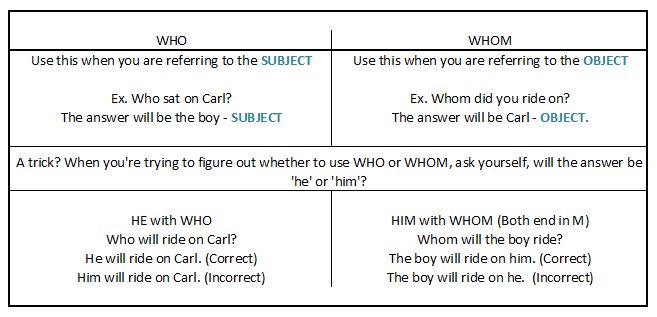
The who/whom question is a tricky one. Part of it sounds easy--use who in the subjective position--when you are talking about the subject. Or use who any time you could use he--he/who.

Use whom in the objective position--when you are talking about any object (object of the preposition, direct object, indirect object, etc.). Or use whom any time you could use him--him/whom.

But the problem is a little bigger than that because you can't just take who out and substitute he and hear the correctness:

Is Ray the one who is coming to dinner?

Is Ray the one he is coming to dinner?

Actually, to tell whether you need to use who or whom, you have to do two steps, and the second step is rather laborious:

1. Remember the little trick from above:

he/who
him/whom

2. Then reword the sentence so that you can answer the question with he or him--and use the who or whom that goes with your answer (he/who and him/whom).


I'm going to walk through several of these to help you because it takes a while to do this automatically and correctly:


1. She is the one who doesn't care.
      a. Who is the one who doesn't care?
      b. He is the one who doesn't care (not Him is the one...).
      c. So use WHO (He/Who)

2. It was that girl who stole the candy.
    a. Who stole the candy?
    b. He  stole the candy (not Him is the one...)
    c. So use WHO.(He/Who)

3. I have never seen anyone who could type that fast.
   a. Who could type that fast?
   b. He could type that fast (not Him could type that fast..)
   c. So use WHO (He/Who)

4. I just want whomever is the very best to win.
   a. Who do you want to win?
   b. I want him to win (not I want HE to win..)
  c. So use WHOM (Him/Whom)


5. We will be there at the door to greet whomever.

   a. Who will you greet at the door?
   b. You will greet him at the door (not greet HE at the door...)
   c. So use whomever (Him/Whom)

6. She should just tell whomever.
   a. Who should she tell?
   b. She should tell him.(not tell HE..)
   c. So use whomever (Him/Whom)


More tomorrow! 


Wednesday, July 13, 2011

Day 127: Reflexive Pronouns


Last week we discussed subjective (used as subject) and objective (used as object) pronouns. If you are one who is unsure of whether to say “Then she gave it to her and I” or “Then she gave it to her and me,” go back and read those last two posts for help.

I want to continue with the pronoun theme, but discuss the use of myself. This actually trips me up more often than I care to admit, and I study grammar and writing on a daily basis!

First of all, myself, yourself, and ourselves are pronouns known as reflexive pronouns. That is, they reflect back to the antecedent (a noun or pronoun earlier in the sentence).

 When we say that Donna is the antecedent to herself in the sentence “Donna gave herself a pat on the back,” we are saying that herself is a pronoun and Donna is the antecedent (the word that herself refers back to).

So, reflexive pronouns reflect or refer back to another word. They cannot be used alone (i.e. myself can not be used without a noun or pronoun earlier in the sentence (as its antecedent).

1.       I bought myself some candy. (Myself refers back to/is reflexive of I.)
2.       Donna bought herself some candy. (Herself refers back to/is reflexive of Donna.)
3.       He looked at himself in the mirror. (Himself refers back to/is reflexive of He.)

The key to understanding and using reflexive pronouns is to not use them by themselves!

Thus, you wouldn’t say the following:

1.       Ray and myself went to town. (There is no noun for myself to refer back to. You need the subjective I in this sentence…Ray and I.)
2.       They gave it to him and myself. (Same thing—no noun or pronoun for myself to refer back to.)

Thursday, July 7, 2011

Day 125: Subjective and Objective Pronouns Part II of II

So why do you need to know the difference between subjective and objective pronouns if you are not likely to say Me going to town or Give that to I?

The problem with the subjective and objective pronoun does not occur when only one pronoun is present (though I do occasionally hear someone say something like, “Them aren’t ripe yet…”

The problem comes when you have two pronouns at or near the beginning of your sentence (subjective pronouns, hopefully!) or two pronouns at or near the end of your sentence (objective pronouns, hopefully!):

Subjective:
1.      She and I are coming over.
2.      He and she are late.

Objective:
1.      Give that gift to him and her.
2.      We will present them and her with a gift later.


“Single Pronoun Test”: The key to using the correct pronouns in this case is to say each pronoun by itself in the sentence (without the second one) to see if it sounds correct:

1.      Correct: She and I are coming over.
a.       She is coming over.
b.      I am coming over.
2.      Incorrect: Her and I are coming over.
a.       Her is coming over (wrong!).
b.      I am coming over.


3.      Correct: Give that gift to him and her.
a.       Give that gift to him.
b.      Give that gift to her.
4.      Incorrect: Give that give to him and she.
a.       Give that gift to him.
b.      Give that gift to she (wrong!).


The problem also occurs with a pronoun and noun combination:
 
1.      Correct: Jon and I are coming over.
a.       Jon is coming over.
b.      I am coming over.

2.      Incorrect: Jon and me are coming over.
a.       Jon is coming over.
b.      Me is coming over (wrong!).


3.      Correct: Give that gift to Jake and her.
a.       Give that gift to Jake.
b.      Give that gift to her.

4.      Incorrect: Give that gift to Jake and she.
a.       Give that gift to Jake.
b.      Give that gift to she (wrong!).


Again, unless you are 100% sure of your subjective and objective pronouns (and even then you might have tricky situations in which the "Single Pronoun Test" would help), you can run into problems with pronoun use.

Use the “Single Pronoun Test” when you are unsure—and you will almost always “hear” the correct way to write it/speak it.

Wednesday, July 6, 2011

Day 124: Subjective and Objective Pronouns Part I of II

Without being too heavy on the grammar (which is nearly impossible when talking about writing or speaking, which is why it is important that grammar is paired with writing whenever possible). I want to discuss subjective and objective pronouns--and when to use each one.

First, we teach our students in our books that a pro-noun is "for a noun"--that is, it often takes the place of a noun. This is the most elementary description of a pronoun and one that is often accurate. (Of course, there are various classes and types of pronouns that can be extremely confusing, but for the instruction in subjective and objective ones, we will stick with the idea that pronouns are FOR nouns.)

Most everybody knows that we say I at the beginning of a sentence: I am going to the store.

And we say me at the end of a sentence: Give it to me.

But do we really know why?

The reason is because at the beginning of a sentence, generally speaking (and not utilizing sentence openers before the subject), the first part of a sentence contains the subject.

And generally speaking, a word at the end of a sentence is not a subject, but is an object.

And we all know that it is wrong to say Me am going to the store and Give it to I.

We usually understand that pronouns that are used as subjects (that is, subjective ones) include, but are not limited to, I, you, he, she, they, we. (Remember, these are used to tell who are what is doing the action--the sentence's subject.)

We also usually understand that pronouns that are used as objects (that is, objective ones) include, but are not limited to, me, you, him, her, them, us.

So...why worry about subjective and objective pronouns at all? Join us tomorrow to find out!